3 Theoretical and empirical background
3.1 Market justice preferences
Welfare states have undergone several institutional transformations in recent years, with private expansion strongly penetrating social services alongside public provision (Busemeyer & Iversen, 2020). Such processes have led to changes in the architecture of the institutions responsible for social welfare. On the one hand, private companies operate as service administrators of benefits based on the user’s ability to pay, whereas on the other hand, public providers have reorganized to compete as quasi-markets (Lindh, 2017). Besides changes at the formal level, the commodification of social services shapes cultural norms and beliefs, where markets operate as moral projects (Fourcade & Healy, 2007; Koos & Sachweh, 2019).
Due to the processes of commodification that educational systems have undergone in recent decades, education has become one of the key dimensions in the study of market justice. The introduction of market logic into educational institutions has largely led to the loss of education’s intrinsic value in its commitment to equal opportunity, with the generation of monetary value taking precedence over everything else (Abowitz & Stitzlein, 2018; Ball, 2004; Brancaleone & O’Brien, 2011; Piketty & Sandel, 2025; Satz, 2010). In the Chilean context, the market has come to be seen as an inseparable element of education, to the point where it is referred to as the “education market” rather than education itself (Corvalán et al., 2016). The education market has been sustained over the past 50 years by the neoliberal policies implemented during the dictatorship (1973–1989), which have established the predominance of private institutions over public ones in terms of educational quality, leading to a proliferation of educational inequalities in areas such as student outcomes, school segregation, and school infrastructure, to name a few (Bellei, 2016, 2025; Canales et al., 2016; Ramos, 2022; Valenzuela et al., 2014). Consequently, the education market—where the quality of and access to education depend on how much money families have—does not allow educational opportunities to be distributed fairly.
The field of distributive justice has gradually incorporated market preferences into attitudinal research on redistribution. Since Kluegel’s seminal work (1981) on the normative foundations of beliefs about social stratification, the concept of market justice preferences has been developed, understood as the normative principle that legitimizes access to goods and services according to an individual’s or family’s ability to pay (Lane, 1986). This principle is closely linked to the justification of inequalities: by conceiving the market as a space of equal opportunities, economic success is interpreted as an individual achievement (J. R. Kluegel et al., 1999), disregarding the structural conditions that produce such disparities. In this way, market justice operates simultaneously as an economic and moral principle that legitimizes socioeconomic inequalities.
Most research in this field relies on survey data, in which questions about market justice directly probe support for the provision of social services—education, pensions, and health care—based on individual ability to pay (e.g., “Is it fair that high-income individuals receive better education than low-income individuals?”) (Busemeyer, 2013; Lindh, 2015). Within this framework, International Social Survey Programm (ISSP) has been the primary source for advancing this agenda. Also, recent research has employed a separate analysis of each item (Castillo, Iturra, et al., 2025; Castillo et al., 2026), but also have been implemented indexes constructed from relevant items (Castillo, Laffert, et al., 2025).
Recent literature on market preferences has identified significant associations mainly at individual level. Socioeconomic status emerges as a consistent predictor; those in more advantaged positions tend to exhibit greater preferences for market justice (Koos & Sachweh, 2019; Lindh, 2015), a pattern reflecting a moral economy that justifies status for those who benefit from the market order. In this regard, political ideology shows a clear association, with right-leaning individuals tending to favor market-oriented distributional principles (Castillo et al., 2024; Lee & Stacey, 2024). Along the same lines, meritocracy has emerged as another important factor associated with market justice, where the meritocratic narrative has been positively correlated with pro-market positions (Castillo et al., 2024; Castillo, Iturra, et al., 2025; Castillo et al., 2026; Heuer et al., 2020). In this research, I focus in the individual level factors related to market justice in education, specially on meritocracy as a catalyst for justifying inequalities.
3.2 Meritocratic beliefs
When discussing education, it is difficult not to encounter the concept of meritocracy. Based on Michael Young’s work The Rise of Meritocracy (1962) (2017), this concept is understood as the distribution of rewards based on effort and talent. For their part, schools award credentials that reflect students’ performance in various subjects. In this sense, meritocracy is a fundamental element of every educational institution, as it is one of the principles governing the awarding of credentials. Thus, beliefs about the educational system are often closely tied to meritocracy (Clycq et al., 2014; Darnon et al., 2018).
In the field of education, meritocracy has been used as a distributive principle, but within this framework, it has also been linked to the justification of inequalities. Starting from Adams’ theory of equity (1963), meritocracy operates as a universal equality principle, where rewards should be commensurate with effort. Several studies have shown that meritocratic beliefs are associated with individualistic beliefs, such as an aversion to redistribution and a preference for market justice (Bartram, 2023; Castillo et al., 2024; Castillo, Iturra, et al., 2025; Mijs, 2021; Sin et al., 2026), and are characteristic of those in more privileged social positions (Heuer et al., 2020). In these cases, meritocracy is used to legitimize positions, with those who benefit from the system often justifying their success on the basis of their own merit, overlooking the structural conditions that shape reality. Thus, the merit narrative is linked to support the idea that money should determine the quality and access to education. This normative judgment runs counter to educational justice, as it hinders equal opportunities and, ultimately, determines students’ educational trajectories (Moyano, 2020; Walzer, 2010).
In the meritocracy research framework, most studies have used surveys to respond their research questions, with the International Social Survey Program as the main instrument for measuring and analyzing meritocratic beliefs in both national and international contexts. These items show the relevance of meritocratic and privilege factors for getting ahead in life, like effort and contacts, respectively. Following this conceptual model, there is a tradition of studying meritocratic beliefs from a unidimensional perspective (García-Sánchez et al., 2019; Mijs, 2021). The problem with this approach is that it has serious implications for understanding social reality, since it assumes that people’s beliefs follow a rational logic in which, if a belief in meritocracy is stronger, a belief in privilege must be weaker. To address this, in recent years, some authors have proposed a multidimensional perspective on meritocracy, constructing frameworks that allow for distinguishing the dimension of merit from that of privilege, on the one hand, and differentiating perceptions from preferences on the other (Castillo et al., 2023; Duru-Bellat & Tenret, 2012; Zhu, 2025). These advances have led to two key contributions: (1) to capture the coexistence of beliefs that may be considered contradictory and, consequently, (2) to demonstrate that people can hold different sets of meritocratic beliefs.
While the multidimensional perspective on meritocracy allows for a more detailed examination of people’s beliefs, a caveat remains about the individuals who hold them. So far, we do not know how different combinations of these dimensions operate in people’s minds or how prevalent they are in populations. Several methods have addressed these issues by estimating how variables can group into persons, with Latent Class Analysis (LCA) among the most promising approaches. LCA is a person-centered approach that allows us to identify the heterogeneity of individuals’ beliefs by clustering them, going beyond the scope of variable-centered methods, which assume that the association between two or more variables in the population behaves uniformly (Cech & Blair-Loy, 2010). In our context, one advantage of this approach is that it accommodates the possibility that individuals may hold both meritocratic and structuralist beliefs, allowing for a theoretical and methodological examination of multidimensional meritocracy (Nylund-Gibson & Choi, 2018; Zhu, 2025).
Although LCA allows us to identify different configurations of meritocratic beliefs, it is not possible to define in advance the types of patterns that will be found. In this regard, the evidence suggests that one of the most likely patterns is a predominant meritocratic beliefs, in which individuals consider merit important and structural factors unimportant (Heuer et al., 2020; Xian & Reynolds, 2017; Zhu, 2025). On the other hand, a pattern has also been identified in which success is attributed to family and background conditions rather than effort (C. Palomino & Sebastian, 2026). Finally, a pattern of dual consciousness has been identified, in which individuals consider merit, family connections, and wealth to be important (Zhu, 2025). Therefore, based on previous studies, this research expect to find at least three types of groups based on meritocratic beliefs: a meritocratic-dominant latent class viewing merits as important while deeming privilege factors as irrelevant; a class characterized by aware of privilege, viewing privilege factors as important while deeming merits as unimportant, and finally a dual consciousness class, viewing merits and privilege factors as important simultaneously.
Each pattern of meritocratic beliefs can be situated within a framework of meaning related to a preference for market justice in education. As the literature suggests, the perception of meritocracy is widely associated with the legitimization of inequalities—and specifically with market justice—so it is to be expected that the first group would adhere to this pattern (Castillo, Laffert, et al., 2025; Castillo, Iturra, et al., 2025). With regard to the second group, the prevalence of privilege could be directly associated with disagreement over education-market justice preferences, since observing that society distributes rewards based on factors unrelated to merit might seem unfair (Alesina & La Ferrara, 2005). Finally, the pattern of dual consciousness may demonstrate that the recognition of merit and privilege in the functioning of society could imply an understanding that structural conditions play an important role in individual outcomes, leading to opposition to the idea that access to and the quality of a service such as education should be based on economic conditions (Xian & Reynolds, 2017; Zhu, 2025). Based on the above, the following hypotheses emerge:
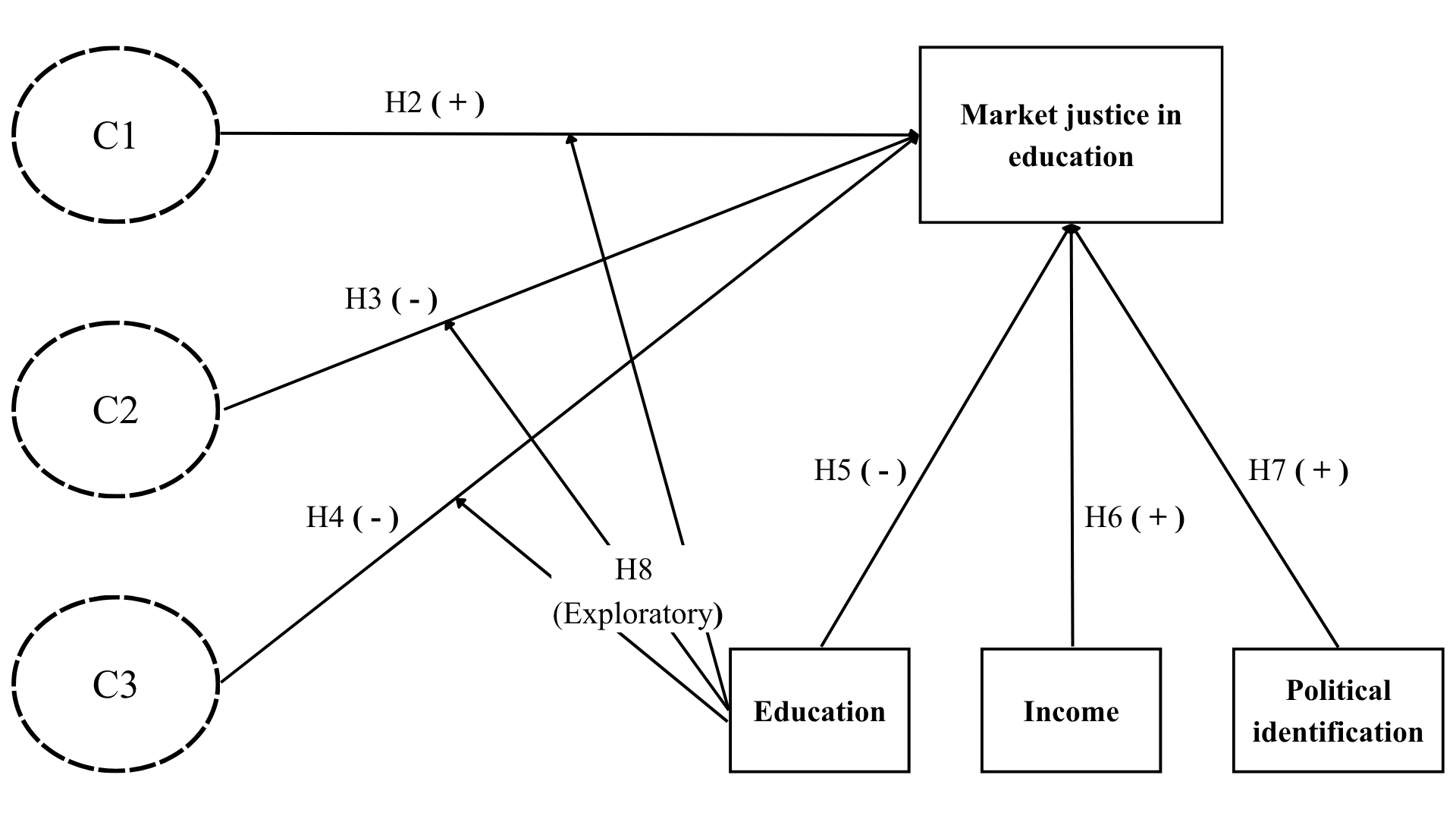
\(H_{1}\): Predominant meritocratic beliefs class shows a positive association with education market justice preferences
\(H_{2}\): Aware of privilege beliefs class shows a negative association with education market justice preferences
\(H_{3}\): Dual consciousness beliefs class shows a negative association with education market justice preferences
3.3 Estatus, political ideology and moderation
3.3.1 Education
There are various theories regarding how educational attainment affects people’s redistributive preferences. On the one hand, there are theories that view education as a resource that enhances the development of technical skills and/or critical thinking, leading individuals to become aware of structural problems and, as a result, to support the reduction of inequality (Becker, 1993; Freire, 2015; Schultz, 1961). On the other hand, in cultural reproduction theories, education has been understood as a source of social inequalities, as it reproduces individuals’ living conditions, preventing opportunities for intergenerational social mobility and, consequently, perpetuating the stratified social order (Bourdieu, 2019; Bowles & Gintis, 2011). Within the framework of redistributive preferences, reproductionist notions are grounded in self-interest theory, whereby those with higher levels of education tend to exhibit attitudes that reflect a desire to protect their privileged social positions, which could be understood as an aversion to redistribution or support for market-based justice. Thus, education can be understood not only as an enlightening force in social life but also as a cog in the reproduction of inequalities.
Recent literature provides empirical support for both reproductionist and enlightenment approaches to education. In support of the reproductionist approach, research by Nye et al. (2026) found, in an analysis of 282 country-year combinations from various international surveys, that in 95% of cases, individual educational level was positively associated with market-oriented attitudes. Likewise, Van Noord et al. (2019) used data from 31 countries to show that education is widely understood as the basis for social stratification. In support of the enlightenment approach, Busemeyer (2012) found that higher levels of education are associated with a greater preference for public investment. However, the results from Liu & Wang (2026) suggest that education does not fulfill a generalized function; rather, both the enlightening and the reproductionist roles coexist but depend on the level of education. In countries with low inequality, basic education is associated with reproductionist positions, while secondary and tertiary education highlight the enlightening role.
Given the important role that education plays in shaping individuals’ attitudes toward inequality, this study proposes the following hypothesis:
\(H_{4}\): Individuals with higher levels of education show higher education market justice preferences
3.3.2 Income
In addition to educational level, the literature has shown that income is also an important factor in the study of attitudes toward inequality (Heuer et al., 2020; Lindh, 2015). The evidence shows that higher-income individuals tend to support market-based distributive principles (Immergut & Schneider, 2020; Lindh, 2015; Nye et al., 2026). In this context, among higher-status social groups, there is congruence between their attitudes and their individual outcomes—that is, a legitimization of the market as a distributor of rewards, serving as a justification for social status. Although the link between income and market justice can be tied to self-interest theories, Langsæther & Evans (2020) argues that social status does not always provide a rational explanation for attitudes toward inequality, making it necessary to test this relationship. Based on the literature, the corresponding hypothesis is:
\(H_{5}\): Individuals with higher incomes show higher education market justice preferences
3.3.3 Political ideology
Political ideology also influences people’s attitudes toward inequality. In this regard, the scientific literature has shown that people with right-wing political ideologies tend to support a market-based distribution of welfare (Lee & Stacey, 2024). Meanwhile, (Van Hootegem, 2022) found that right-wing individuals are less likely to adopt positions that support equity and equality. This finding is consistent with the study by Castillo, Iturra, et al. (2025), which found that only individuals identifying with right-wing ideologies showed a positive correlation with a preference for market justice in education. In this context, the following hypothesis is proposed:
\(H_{6}\): Right-wing individuals show higher education market justice preferences than those belonging to the left-wing
3.3.4 Moderation
Finally, I examine the moderating role of education in the relationship between meritocratic belief patterns and preferences for education market justice. Given that is expected education may play a reproductionist role, it would be interesting to observe how educational level can amplify the relationship between each latent class and education market justice preferences. Since I do not have sufficient evidence to support this hypothesis, this analysis is exploratory. Thus, the following hypothesis emerges:
\(H_{7}\): Classes that are positively associated with education market justice preferences show an amplified effect when moderated by educational level
3.4 This study
this study argues that implementing a private social services architecture has consequences for the population’s normative judgments, with meritocracy emerging as a driving force shaping people’s conceptions of justice in the educational sphere. Meritocracy has been used as a narrative to define success and failure in terms of individual responsibility, especially in educational institutions where meritocracy plays a central role, so considering that, further argue that meritocratic beliefs provide a key normative lens through which individuals evaluate education inequalities. Based on this argument, this study aims to further explore the research area of market justice and meritocracy through two innovations: First, the identification of different belief systems in Chile using a multidimensional framework of meritocracy, combined with a person-centered method, distinguishing the heterogeneity of beliefs in terms of the size and number of recognizable systems. Second, to explore how each meritocratic belief system relates to preferences for market justice preferences in education. Thus, this study aims to demonstrate that meritocracy can function differently as a mechanism for legitimizing inequalities in education, and that this difference in its functioning as a mechanism can only be observed by acknowledging the heterogeneity of beliefs within the population.
In light of the foregoing, it is worth analyzing this phenomenon in Chile, a country that offers an interesting case for examining how public attitudes toward the distribution of social services are affected by market-oriented welfare institutions. Chile is one of the most unequal countries in the OECD, with a high concentration of income and wealth in the top decile (Chancel et al., 2026; Flores et al., 2020). This inequality is largely attributable to the neoliberal reforms of the civil-military dictatorship, subsequently expanded by democratic governments, which privatized and commodified key spheres of social reproduction through concessions and regulatory frameworks favorable to private provision (Madariaga, 2020; PNUD, 2017). This model has produced structurally segmented systems in health care, education, and pensions, where access and quality depend on the ability to pay, benefiting higher-income sectors and relegating the poorest to limited, underfunded public alternatives (Boccardo, 2020; Castillo, Laffert, et al., 2025). In detail, the education system is characterized as one of the most privatized in the world, where the quality of private education surpasses that of public education due to the limited regulation of the education market, and where high levels of private-sector investment coexist with a lack of public funding (Bellei, 2025; Ramos, 2022; Valenzuela et al., 2014). Thus, in a context marked by high and durable inequalities, a well-established education market, and the entrenchment of meritocratic beliefs, it becomes relevant to examine the link between meritocratic beliefs and preferences for education market justice (Castillo, Laffert, et al., 2025). Ultimately, this research aims to explain how market-based normative beliefs may prevent educational institutions from ensuring equal opportunities, thereby bringing educational justice to the forefront of public discussion.